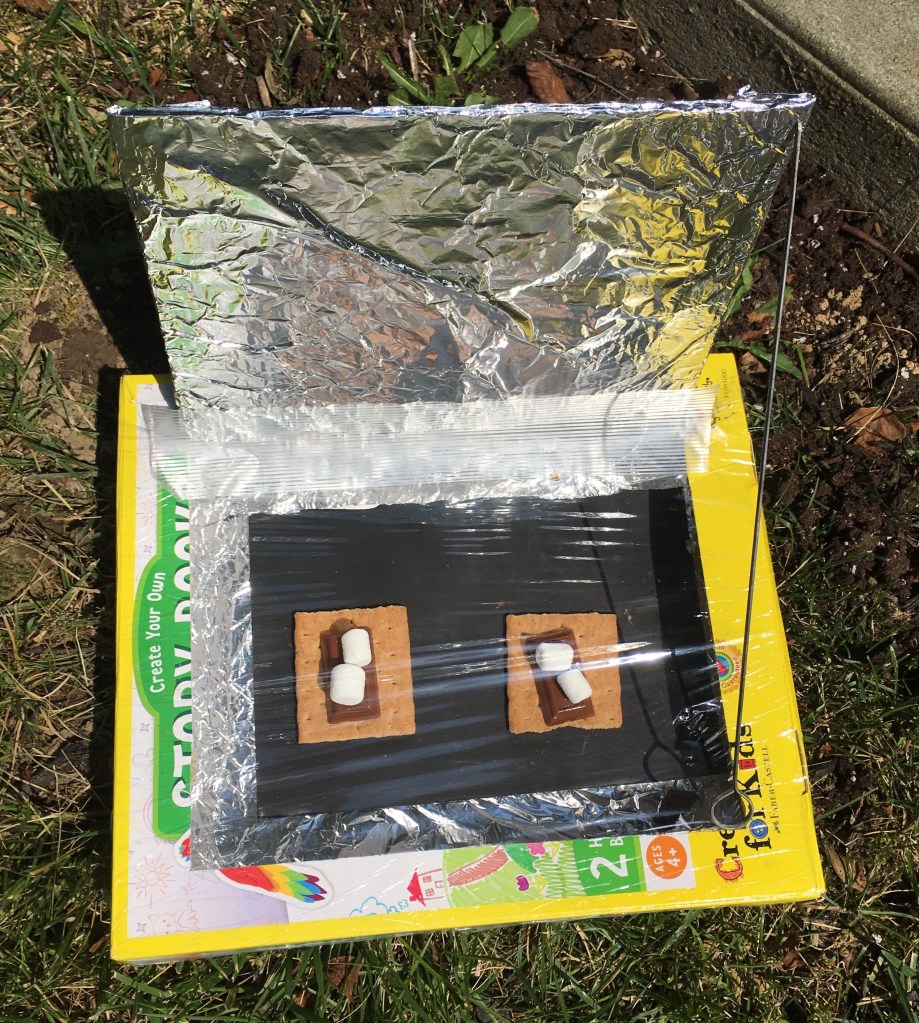
This DIY Solar Oven is an interesting project to study how sun’s energy can be used as a clean source of power. It not involves a interesting steps of crafting but also each step demonstrates important concepts of science involved.
Well, we had made a solar oven for our experiment long back but couldn’t test it since the weather was not hot enough or the day was just not right. We had thought of baking s’mores in this oven. Luckily, we could get all the things right to test this very dear project of ours. After all it involved a tasty treat at the end!
What you need
Cardboard box with attached lid
Aluminum foil
Plastic wrap
Black construction paper
Tape
Glue stick
Skewer or a stick
Xacto knife (or scissors)
S’mores supplies: grahams, chocolate, marshmallows
How to make a solar oven?
1. Using an xacto knife, cut a three-sided flap out of the top of the box, leaving at least a 1-inch border around the three sides.
2. Glue aluminum foil to the inside of the top flap, keeping the foil as smooth as possible. The foil reflects the sun into the oven.
3. Line the inside base of the oven with aluminum foil, again keeping it as smooth as possible.
4. Glue a black construction paper to the bottom of the box. The black color absorbs the heat.
5. Tape the plastic over the opening of the door. This will allow the air inside the box to heat up but keep the heat trapped inside the box.
6. Place a graham cracker, marshmallow, and chocolate inside the oven.
7. Place your oven outside in the sun (so that the top lid faces the sun). Use a skewer or a stick to prop the lid open at an ideal angle.
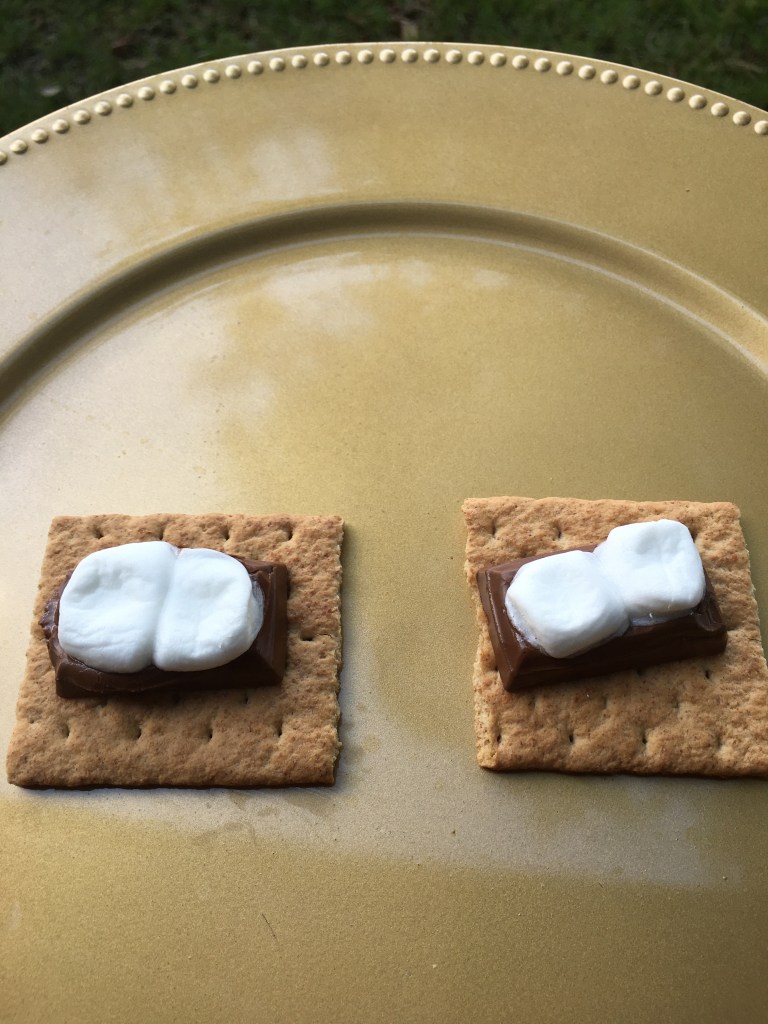
The chocolate will start transforming into soft squishy state and the marshmallows will look more puffed up from the heat. It took us about 90 minutes to bake our s’mores. The temperature outdoors was around 100 degree Fahrenheit. You can just wait until the chocolate melts and can be called good enough, and your tasty treat is done. Place another graham over the baked graham or just sandwich the two of the baked grahams. Time to feast on your solar oven s’mores!

Functions of the components of the Solar Oven
Aluminum foil: The sunlight is reflected when it strikes its surface.
Black construction paper: Since black absorbs maximum light, it absorbs the light reflected from the aluminum foil. In the oven, the light energy is transformed into heat energy which demonstrates the law of thermodynamics which states that energy can’t be destroyed but can be only transformed from one state to the other.
Plastic wrap: It traps the heat radiated from the black construction paper causing the temperature inside the oven to rise.
Cardboard box: It serves as a physical oven and acts as an insulator of heat.
Science behind the working of the Solar Oven
A solar oven works by energy from the sun that penetrates into the surrounding environment thus demonstrating the process of radiation.
The shiny surface catches the sunlight and acts as a reflector reflecting it onto the base surface of the oven. The base surface gets heated. This heat is transfered to another object through direct contact thus demonstrating the process of conduction.
Further the air that is trapped inside gets heated by the process of convection which occurs when warm air which is less dense rises up and the colder air which is more dense sinks.
We are using a black sheet of paper for the base surface since black color absorbs maximum light and is transformed into heat energy. Plastic wrap prevents the hot air inside the oven from escaping thus creating a Greenhouse effect.
Notes:
1. Solar ovens slow-cook food on a low heat over a longer period of time than conventional ovens, but they do work.
2. The box should be tightly sealed or insulated to prevent the heat from escaping.

 Mom's Diary